
There is so much overlap between strategies used in the classroom with children and those with ADHD regardless of the age. If you struggle to maintain executive functioning skills on your own once you leave the confines of the classroom and supervision of your teachers, you are not alone. Sometimes (often), we need to employ some techniques that we may have learned in school, or were utilized with us in someway when we were younger. Such is the life of an ADHDer – no shame in that!
One of the behavioral strategies often used with children who struggle to follow behavioral expectations is something called behavioral momentum. Outside of the classroom and in more clinical spaces, this can be looked at as habit stacking. So, what is habit stacking?
What is Habit Stacking
For children and learners in the classroom, behavioral momentum is often utilized, which involves making requests that are easy (high-probability or HP) before making requests that are more challenging (low-probability or LP). By delivering a series of HP requests before the target, or LP request, you increase the learner’s motivation to cooperate because you are building in many opportunities for success.
If you are an adult or young person with ADHD, how can you make this strategy work for you? That’s where habit stacking comes in. For those with ADHD, following expectations can be hard. Between inattention (the inability or challenge of maintaining attention on expectations), hyperactivity (when our bodies have too much stimulation and we can struggle to sit still), and impulsivity (difficulty with maintaining self-control), it’s not about defiance, but a natural consequence of ADHD. As a result, it can be very hard to maintain or even motivate ourselves to engage in these LP behaviors. By engaging in higher probability behaviors (your habits) and adding one lower probability behavior (the one you want to start doing regularly), you are more likely to start engaging in this behavior more in the future since you’ll have the momentum to complete the task.
How to Habit Stack
This strategy is simple to implement. Habit stacking can be utilized with learners of all ages, but works best with those who are self-monitoring their behavior and/or young adults and adults with ADHD.
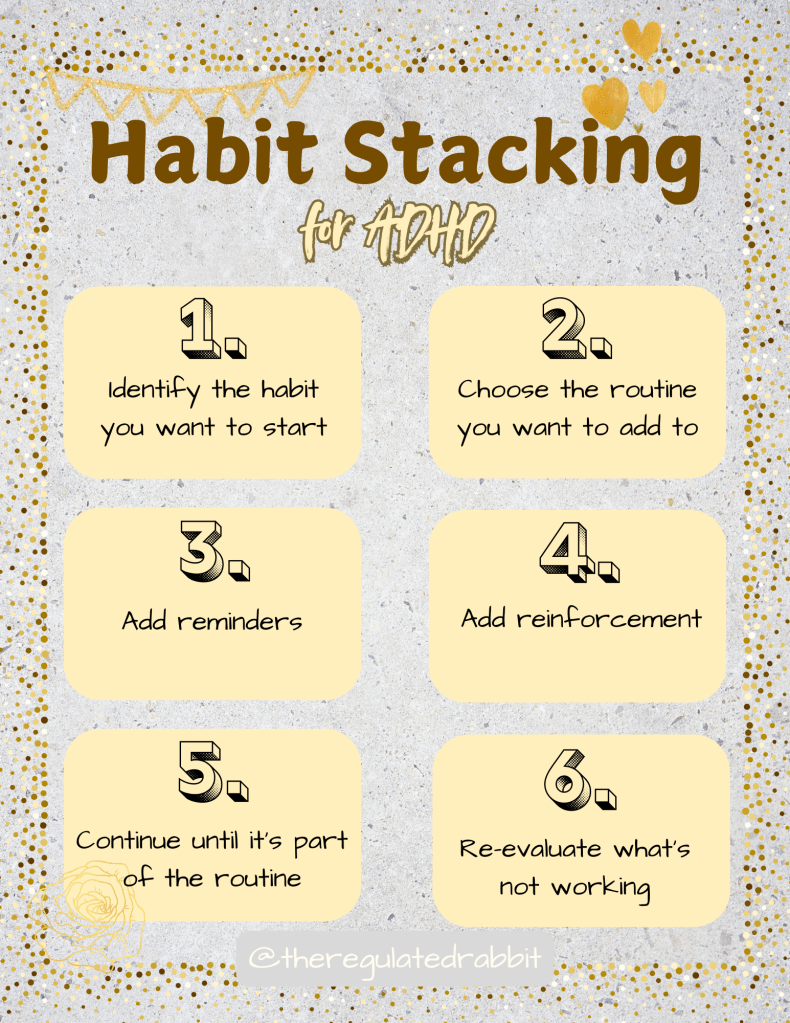
Step 1: Identify the behavior you want to add/change (LP).
What is it that you’re trying to do? Do you want to start drinking water when you first wake up? Want to make time in the morning for a walk? Need to make a doctor’s appointment you’ve been avoiding? Figure out the behavior you want to add or change, focusing on more “simple” behaviors that have a definitive start and stop, limited steps to complete, or those with “quicker” results. More complex behaviors (such as deep cleaning the kitchen, doing your taxes, rake the leaves) can benefit from other strategies such as “following the dopamine”, automation, or time-blocking, although sometimes habit tracking can work with these too.
Step 2: Choose the routine or habit you want to add this new behavior to
Once you identify what it is you want to do, think about when it makes the most sense to add it. For example, if you want to start drinking water first thing in the morning, tack it onto your already established morning routine, whatever that looks like. You don’t need to have a robust system in place for this to work. If your current morning routine looks like rolling out of bed, turning on the light, and making coffee, that’s enough. Add “drink water” after you make your morning coffee and pour yourself a glass.
Step 3: Add visuals or audio reminders
Make sure you add visuals or auditory reminders to help you to remember this step in your routine. If it was enough to just say you’re gonna do it, you would just do it. I often try to add a seemingly simple task to my day, only to forget about it the moment I stop thinking about it. By adding visuals (sticky notes, physical items to your space such as an empty glass next to your coffee maker) or auditory reminders (alarms, recruiting phone calls/texts, timers), you can help set yourself up for success even more.
Step 4: Reinforce your efforts
There’s a couple different ways you can approach reinforcement here. The typical way is to reward yourself after you complete the necessary task. So, in this example, you poured yourself a glass of water and you took some sips while you drank your coffee. Then, praise the heck out of yourself, or give yourself a tangible reward. Recruit reinforcement from others (text a supportive friend and tell them you drank water this morning, which is something you’re trying to start doing. I’m sure they’ll give you a virtual pat on the back, even if it is contrived.) if it helps.
Another way to provide yourself reinforcement (which, as a reminder, is a way to increase the likelihood that you will continue this behavior in the future), is to make the task itself more reinforcing or fun to do. In this example, you might add something to your water to make it more enticing and novel (such as cucumbers or a flavor) or even putting it in a fun glass or water bottle. It sounds silly, but sometimes it’s the smallest things that can help motivate us the most.
Step 5: Continue this sequence until it becomes routine
As with any habit, the more consistent you are, the more routinized it becomes. Continue steps 3 and 4 until it sticks! You may need to play around with the reinforcement or the prompts, because as we know, monotony is the death of creativity to an ADHDer. And nobody stifles our creativity and spunk! So, you may need to alternate what you do to entice yourself to engage in your behavior, or use different colored sticky notes, or play around with their placements. I’ve been known to change an alarm to a novel sound just to make sure it actually alerts me enough for me to pay attention. Do what you can do to help make this stick!
Step 6: Re-evaluate if it’s not working
If you are finding yourself still struggling to engage in the behavior you chose, analyze what’s going on. Is the behavior or habit you want to add ill-fitted for the routine you tried to add it to? Do you want to change the behavior or did you choose it because you felt you should or need to? Take an honest look at what’s working and what’s not working and try restructuring your plan again.
Give it a go! Save the image below for a quick reference guide to Habit Stacking and get started!
 The Regulated Rabbit
Leave a comment